Human Powered
Vehicles (HPV)
(Varna Orpheus pictures
further down!)
 Lafleur/Varna Record Report - by Paul Buttemer VARNA sets new records! - by Carole Leone Lafleur/Varna Record Report - by Paul Buttemer VARNA sets new records! - by Carole Leone |
The (International Human Powered Vehicle Association) is an association of national associations and organizations, dedicated to promoting improvement, innovation and creativity in the use of human power, especially in the design and development of human-powered vehicles. The HPVA is the former IHPVA and now the association for USA, Canada, and still for all English-speaking individuals worldwide who do not have their own national association. |
LAFLEUR/VARNA RECORD REPORT - by
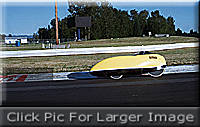
In late July of 1998, Robert
Lafleur, Team Varna
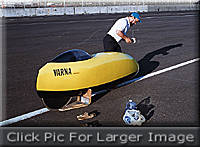 and ), and IHPVA officials (Pierre
Laliberté, , George Leone and
John Tetz) congregated in Blainville, Québec, Canada. PMG Technologies, a company in Blainville, allowed us
the use of their large racetrack to make record attempts in various categories
as recognized by the IHPVA.
and ), and IHPVA officials (Pierre
Laliberté, , George Leone and
John Tetz) congregated in Blainville, Québec, Canada. PMG Technologies, a company in Blainville, allowed us
the use of their large racetrack to make record attempts in various categories
as recognized by the IHPVA.
THE VENUE
 PMG Technologies
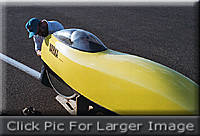
owns a large facility and several tracks. The track we used, called Alpha,
is 6.86 km in length and is very level, the difference between the
highest and lowest point being 3.8 meters. The track is roughly oval, with the
corners and both straightaways all being about 1.7 km long. The front
straightaway has two very slight S-bends. The track surface is hard and has
low rolling resistance, although it was paved about 20 years ago and has some
cracks and repaired sections. The bumps were noticeable, but we
were able to find a path that missed most of the ones that would cause speed
loss, and PMG staff did some beautiful last-minute repair of the very worst
ones.
PMG Technologies
owns a large facility and several tracks. The track we used, called Alpha,
is 6.86 km in length and is very level, the difference between the
highest and lowest point being 3.8 meters. The track is roughly oval, with the
corners and both straightaways all being about 1.7 km long. The front
straightaway has two very slight S-bends. The track surface is hard and has
low rolling resistance, although it was paved about 20 years ago and has some
cracks and repaired sections. The bumps were noticeable, but we
were able to find a path that missed most of the ones that would cause speed
loss, and PMG staff did some beautiful last-minute repair of the very worst
ones.
The sprint courses were set up on the back straightaway,
which is the smoothest section of the track, and has an average downgrade of
about 0.07%, dropping about 1.2 meters in 1700 meters. (This is close to
one tenth the allowable grade - the IHPVA rules allow a 0.67% downgrade, or a
drop of 11.3 meters in 1700 meters.) When Sam made a sprint attempt, he
would take one full lap of the track to gradually get up to about 70 kph,
then would have over 2 km to accelerate to final speed.
and has an average downgrade of
about 0.07%, dropping about 1.2 meters in 1700 meters. (This is close to
one tenth the allowable grade - the IHPVA rules allow a 0.67% downgrade, or a
drop of 11.3 meters in 1700 meters.) When Sam made a sprint attempt, he
would take one full lap of the track to gradually get up to about 70 kph,
then would have over 2 km to accelerate to final speed.
Normally, the weather in Blainville at the end of July is
perfect for HPV riding - daily high temperatures around 25C - 30C, relative
humidity below 50% and calm winds. However, July 1998 was an exception (el
Niño aftermath?). Temperatures were a little colder than expected and the
humidity was higher than normal, but it was the wind that gave us a real scare.
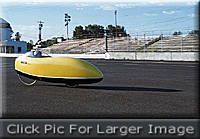 Every day the winds averaged between 25 and 40 kph, and varied up and down in
random cycles. Several places on the course were gusty because of the
surrounding terrain, and as a result, the track was generally not rideable at
all during the day.
On most days there was a window (of calm wind
conditions) in the early morning and just before sunset. The early morning
window was very unpredictable. Sometimes we would get up before dawn, and
the wind would already be howling. Sometimes we would get up, see calm
conditions and hurry to the track only to see the wind rise before we could even
warm up. We were at the track for 15 days, and were only able to take
advantage of the morning window once, for some of Sam's required sprint backup
runs. Paul had one morning 100 km record nullified by winds over the legal
limit. We also missed a couple of morning chances due to bad luck and/or
poor planning.
Every day the winds averaged between 25 and 40 kph, and varied up and down in
random cycles. Several places on the course were gusty because of the
surrounding terrain, and as a result, the track was generally not rideable at
all during the day.
On most days there was a window (of calm wind
conditions) in the early morning and just before sunset. The early morning
window was very unpredictable. Sometimes we would get up before dawn, and
the wind would already be howling. Sometimes we would get up, see calm
conditions and hurry to the track only to see the wind rise before we could even
warm up. We were at the track for 15 days, and were only able to take
advantage of the morning window once, for some of Sam's required sprint backup
runs. Paul had one morning 100 km record nullified by winds over the legal
limit. We also missed a couple of morning chances due to bad luck and/or
poor planning. 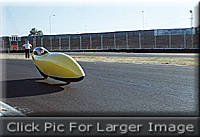 In the evening, the winds would usually calm down to within
legal strength about 30 to 60 minutes before sunset.
Unfortunately, the
temperature would also plummet (making for more air resistance). But, in
the end, we had five evening sessions, four of which resulted in records with
legal wind conditions.
In the evening, the winds would usually calm down to within
legal strength about 30 to 60 minutes before sunset.
Unfortunately, the
temperature would also plummet (making for more air resistance). But, in
the end, we had five evening sessions, four of which resulted in records with
legal wind conditions.
The PMG Technologies facility is actually a proving grounds
and is not suitable for public-view events. All vehicular movement is
governed by a controller, and one must ask permission by radio to enter a track,
and inform the controller when leaving a track. A small paved area and
garage are adjacent to the entrance to the Alpha track, where we were given some
space for our operation. We have discussed the future possibility of
holding a small invitational event on the Alpha track, and the track manager has
agreed in principal.
ACKNOWLEDGEMENTS
We would like to thank
all our officials for their time, patience and proficiency. Each venue
presents unique problems for officiating. 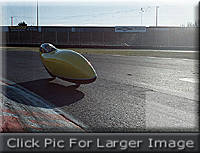 To make attempts on eight
records, we had six different course arrangements which required planning and
time to set up.
The officials were busy all day, every day, and in no way
could the job have been done any better! Pierre took three months out of
his life prior to our arrival to take care of all the thousands of details that
needed to be attended to. The record attempts would not have happened at
all without his help.
To make attempts on eight
records, we had six different course arrangements which required planning and
time to set up.
The officials were busy all day, every day, and in no way
could the job have been done any better! Pierre took three months out of
his life prior to our arrival to take care of all the thousands of details that
needed to be attended to. The record attempts would not have happened at
all without his help.
We would also like thank all the staff at PMG Technologies.
They were always friendly, helpful, and frequently went far beyond the call of
duty to accommodate our unusual and unfamiliar requests. We hope that we
have made a good name for the HPV community at PMG, and that we will be welcome
guests in the future.
RESULTS - - Click here to see a detailed chart of results.
VARNA sets new records! - by
 From July 16 to the 24th George and I were
official observers at a record attempt session by the Varna team outside of
Montreal. The venue was a huge auto test track (approximately a 4 mile oval).
The track had not been repaved in many years and was very bumpy in sections, otherwise I believe the speeds would have been even greater.
After the first week, John Tetz drove up to be an observer, along with Pierre
Laliberte of Quebec,
From July 16 to the 24th George and I were
official observers at a record attempt session by the Varna team outside of
Montreal. The venue was a huge auto test track (approximately a 4 mile oval).
The track had not been repaved in many years and was very bumpy in sections, otherwise I believe the speeds would have been even greater.
After the first week, John Tetz drove up to be an observer, along with Pierre
Laliberte of Quebec, 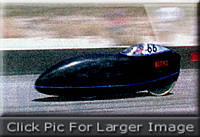 who was the main person who secured the site for the team
and who was an observer the entire time.
who was the main person who secured the site for the team
and who was an observer the entire time.
During the two weeks a total of 7 records were broken by the two Varna bikes and
riders, Sam Wittingham (200 m, 500 m, kilometer, mile and hour) and Paul
Buttemer (10 k and 100 k). Four were better than the high and low altitude
records, three were new low altitude records. One record, the 4000 meter, was
broken by Robert Lafleur. He broke both the previous high and low altitude
records.
CLICK HERE TO VIEW THE WORLD
RECORDS!